Welcome to my blog which follows my furniture restoration business. Please feel free to comment at the bottom of the post, and if you would like a response please leave your email address. you can also contact me directly at info@johnmarkpower.com. And by all means, if you like something please feel free to share it.
Showing posts with label Rush. Show all posts

Tuesday, September 8, 2015

Some Recently Completed Pieces

19th Century English Cherry Dressing Table
I have developed a bit of a backlog of photos of completed work over the past couple of months. In an effort to catch up I am showcasing some of the more interesting pieces that have come through the shop recently. Below I will describe the pieces and the work we did to them.

1. English Lath Back Windsor Chair
 This was one of my favorite chairs to ever come through the shop. It is a Lath Back Windsor made from various woods including beech and elm. It was made sometime in the middle of the 19th century. 

These chairs are great, they have great form and are very comfortable. This one had loosened up so I glued the loose joinery. The wear on the chair was wonderful, especially on the arms, so we simply cleaned and waxed the finish.

2. Four Ladderback Chairs
 
These chairs are pretty run of the mill, and were probably made around 50 years ago. I chose these to showcase the great job my caner did on the rush seats! Beyond the seats, I glued the loose joinery, and cleaned and waxed the finish.

3. Parquet Table with Draw Leaves
I have written about draw leaf table before on this blog. All of the examples that come through the shop seem to be from the early part of the 20th century. This one was made form European walnut and beech. It had a French country style, and was probably made in France or possibly another country on the European continent. This table was in pretty rough shape, so we removed the finish and refinished it with a French Polish finish.


 4. Walnut Breadboard End Table 
This table came from Switzerland and was made from old boards of European walnut. That being said, it was made fairly recently. I liked this table a lot because it reminded me of the first dining table I made, which was also of walnut. The finish was in bad shape, so we refinished this with a French Polish finish.


 5. English Cherry Dressing Table
This was a sweet little table, made from European cherry in the early part of the 19th century. Despite the cabinetmakers attempts to use good straight grained wood, the back legs had warped severely! Because it was stable and there is no real way to fix this, I left them as is. This piece was refinished with a French Polish finish.


6. Walnut Drop Leaf Table
This table had some beautiful walnut veneer, as seen in the photo below. It was made in the 1930s and I refinished it with a French Polish and found a new walnut knob for the drawer.


7. Reproduction John Shaw Four Drawer Chest
This chest was a lovely reproduction of  a chest made by John Shaw (1745- 1829), a cabinet maker from Annapolis, Maryland. The reproduction was made by Biggs Furniture of Richmond, Virginia. The chest, like the original, had beautiful crotch mahogany on the drawer fronts. Quite a lovely piece, reproduction or not!

8. Mahogany Display Stand
 
This stand had a lot of work put into it. The top was edged with inlayed banding, some of which was missing and we had to recreate. We also glued the loose joinery, replaced some of the glass, covered the bottom with felt, and refinished the entire case.


I am sure I have more photos like these so I will probably be putting together another post soon of pieces that were recently restored.

Sunday, July 17, 2011

Mid-Atlantic Ladderback Arm Chair (ca. 1780) Part 2

Well, I finished the restoration and repair of the ladderback arm chair I have been working on. It is always an enjoyable experience working on and spending time with a piece of furniture this old. I find my mind imagining the hands that created this piece as well as the many hands that it passed through. After all, isn't this why we are drawn to these things? Each piece is a direct link to another time and place, giving us a small glimpse of what life was like and how our ancestors thought about things. From the intention of the piece, to it's manufacture detail, to its subsequent use, all shed light on a piece of our collective history. Personally, Taking a chair apart like this and studying it to see what I can find out gives me a sense of communion with it's maker that gives the whole project a new purpose. We are fortunate to have these crafted pieces of art to admire in this day and age.

Once the joinery was reassembled on this chair, the next step was to clean the existing finish and build it back up. A previous owner had used linseed oil to "feed" the finish, resulting in a build up on the finish. This is usually a hard thing to remove, but it came off a little easier on this chair. After the surface was brought down to a consistent level, I applied new finish to the old in a process known as amalgamation. With a few coats of new finish, the chair developed a nice sheen, while still displaying the many signs of use. Below are a few photos of the chair, starting with the chair after my work was completed. The chair was then sent to the caner Chris Frear for a new rush seat. As always, Chris did a perfect job on the seat. The last few photos show the chair after it the seat was put on and ready for delivery.


Two small notes about the chair:


1) I do think that the chair was originally painted blue. My hunch is that the maker probably made the chair to be either finished clear or painted and that in this case it was painted. Not knowing the final finish on the chair during the manufacturing process, the maker probably decided to put the decorative scribe marks on the finials, in case it was finished clear. Because of the variation of the woods used and their different visual characteristics, chairs like these were often painted in the eighteenth century.  Evidence of white paint was also found showing that this chair went through several different looks. The places where the blue paint were found indicate that it was probably the original finish.


2) One thing I never discussed was the gap between the top slat and the second one down. Usually the slats are evenly spaced. This one has a greater gap between these two than the other slats. I have not seen another example like this and do not see an obvious reason for doing this, but I am positive it was done intentionally. Perhaps future research will shed some light on this.

Friday, May 21, 2010

Three Completed Pieces

Below are some photos of the New England Maple side chair, the Victorian Walnut side chair, and the Queen Anne walnut sofa I have been working on completed. the first pictures of the chairs show the chair once the finish work was completed, and the later photos show the chairs back from the Caner.

Here is a photo of the New England Queen Anne side chair with the finish work completed. I maintained the existing finish and was able to clean and French Polish the chair.


Here are three photos of the chair completed with the new rush seat. A customer asked me recently what rush is, and the answer is that it is a name derived from "Bull Rush Cattail Leaves" which traditionally were collected in the fall from ponds and dried in a barn. To make the seat, the leaves were soaked for some time and then woven into a cord. There is now a man made rush made from paper which is made from the same process. What you see below is the real natural rush which is appropriate for period pieces.


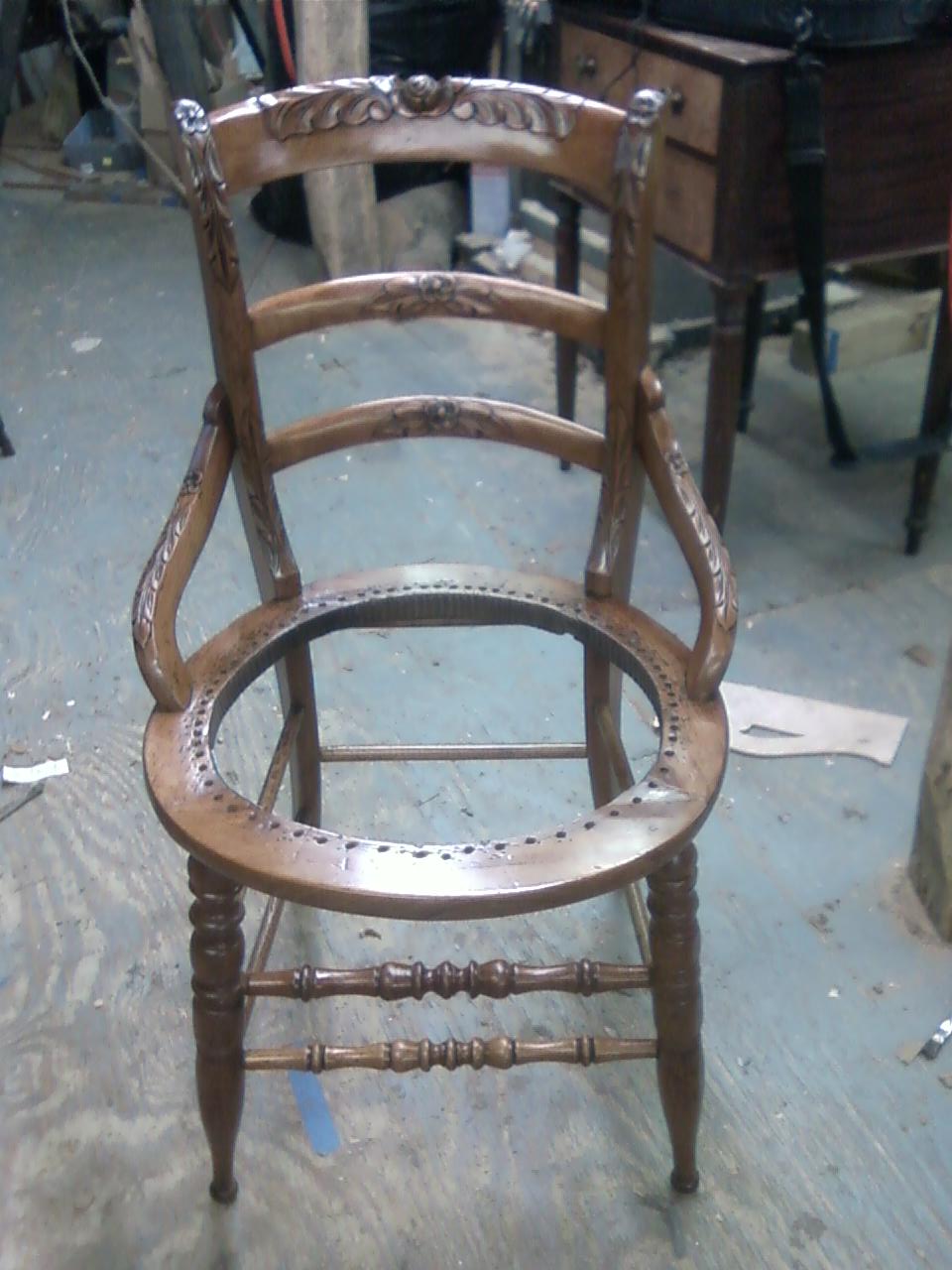
Here is a photo of the Victorian side chair completed before going to the Caner. I fixed some mending plates which were oxidized to look old to the inside rim of the chair to prevent it from breaking again. this is also the original finish restored.Here is the chair back from the Caner. What is interesting about this chair is that the holes in the back of the seat are spaced closer than those in the front, the result is 1) an odd number of holes, and 2) that the seat has a fan effect which can be seen in the photo below.

Last but certainly not least is the Queen Anne sofa. the old upholstery was kept on this piece and all of the restoration concerned the framework of the legs. Once again, this is the existing finish restored.