Welcome to my blog which follows my furniture restoration business. Please feel free to comment at the bottom of the post, and if you would like a response please leave your email address. you can also contact me directly at info@johnmarkpower.com. And by all means, if you like something please feel free to share it.
Showing posts with label Dining Table. Show all posts

Tuesday, September 8, 2015

Some Recently Completed Pieces

19th Century English Cherry Dressing Table
I have developed a bit of a backlog of photos of completed work over the past couple of months. In an effort to catch up I am showcasing some of the more interesting pieces that have come through the shop recently. Below I will describe the pieces and the work we did to them.

1. English Lath Back Windsor Chair
 This was one of my favorite chairs to ever come through the shop. It is a Lath Back Windsor made from various woods including beech and elm. It was made sometime in the middle of the 19th century. 

These chairs are great, they have great form and are very comfortable. This one had loosened up so I glued the loose joinery. The wear on the chair was wonderful, especially on the arms, so we simply cleaned and waxed the finish.

2. Four Ladderback Chairs
 
These chairs are pretty run of the mill, and were probably made around 50 years ago. I chose these to showcase the great job my caner did on the rush seats! Beyond the seats, I glued the loose joinery, and cleaned and waxed the finish.

3. Parquet Table with Draw Leaves
I have written about draw leaf table before on this blog. All of the examples that come through the shop seem to be from the early part of the 20th century. This one was made form European walnut and beech. It had a French country style, and was probably made in France or possibly another country on the European continent. This table was in pretty rough shape, so we removed the finish and refinished it with a French Polish finish.


 4. Walnut Breadboard End Table 
This table came from Switzerland and was made from old boards of European walnut. That being said, it was made fairly recently. I liked this table a lot because it reminded me of the first dining table I made, which was also of walnut. The finish was in bad shape, so we refinished this with a French Polish finish.


 5. English Cherry Dressing Table
This was a sweet little table, made from European cherry in the early part of the 19th century. Despite the cabinetmakers attempts to use good straight grained wood, the back legs had warped severely! Because it was stable and there is no real way to fix this, I left them as is. This piece was refinished with a French Polish finish.


6. Walnut Drop Leaf Table
This table had some beautiful walnut veneer, as seen in the photo below. It was made in the 1930s and I refinished it with a French Polish and found a new walnut knob for the drawer.


7. Reproduction John Shaw Four Drawer Chest
This chest was a lovely reproduction of  a chest made by John Shaw (1745- 1829), a cabinet maker from Annapolis, Maryland. The reproduction was made by Biggs Furniture of Richmond, Virginia. The chest, like the original, had beautiful crotch mahogany on the drawer fronts. Quite a lovely piece, reproduction or not!

8. Mahogany Display Stand
 
This stand had a lot of work put into it. The top was edged with inlayed banding, some of which was missing and we had to recreate. We also glued the loose joinery, replaced some of the glass, covered the bottom with felt, and refinished the entire case.


I am sure I have more photos like these so I will probably be putting together another post soon of pieces that were recently restored.

Thursday, December 12, 2013

Mahogany Dining Room Table with Tulip Wood Banding (Ca. 1920)

The Completed Table
With the holidays comes the inevitable restoration of a dining room table or two and this year has been no exception! One of the tables we restored before Thanksgiving was this beautiful veneered mahogany dining table. There was no name associated with this table save the name on the slides which was the  Watertown Table Slide Company. The Watertown Table Slide Company, of Watertown, Wisconsin, produced table slides for nearly 100 years before being bought by Reiss Industries in 1985. Like Walters of Wabash, the company produced slides for other manufacturers to use in the construction of expanding dining tables. With this in mind, the table itself was not produced by the Watertown Table Slide Company, only the slides. For a look at some history on the company, you can follow the link below. My favorite part is the advertisement stating that the slides work so well that "the gentle effort of a child will extend the table at both ends." I have yet to meet a table where this is the case, but it is nice to dream!


What I can say about this table is that it is a reproduction made in the style of Hepplewhite. The primary veneer used on this table is mahogany, and the table is inlayed with stringing on all of the primary surfaces, including the legs and aprons. The stringing was made up of a light wood (probably holly) and a wide inner band of tulipwood. A bit of clarification here. By tulipwood, I do not mean tulip poplar, which is an American hardwood, but a exotic hardwood found in Brazil that comes from the Dalbergia family, the same family that produces rosewood. Tulipwood was used in the 19th century as a banding material much like satinwood. When first cut or sanded, the wood has streaks of pink to red lines with a pinkish white back drop. As the wood oxidizes over time the red fades from the wood leaving the streaks brown. In some cases fading due to sunlight will almost completely mute the varigation. The other woods used in the banding are probably ebony or perhaps some other darkwood. The combination of these woods is quite nice and contrasts the mahogany backdrop accentuating the lines of the table.

This table had a pretty worn out finish that masked a lot of the design discussed above. The customer and I decided it would look best with a new finish. The table was also in need of repair to the joinery of the aprons and base as well as gluing of loose veneer. below are some photos of the table before, during, and after restoration.

These first two photos show the table before restoration. The second photo shows the inlay on the top barely visible through the old finish.

This photo shows the stamped label for the Watertown Table Slide Company. established in 1889.
These next two photos show missing section on the interior of the apron where the aprons meet the legs. As the table was moved around over the years the pressure from the legs being moved caused them to bend against the apron causing sections to crack and break out.

This photo shows the most severe damage to the joinery. The leg should be vertical, but instead is skewed inward.
To repair this damage, the legs and aprons were removed from the top of the table. The top can be seen top down in the photo below. All of the joinery was disassembled and cleaned of its old glue and missing sections were patched with wood. Once the repairs were made the apron and legs were reassembled with new glue and attached to the top. Several photos of patches being glued in place are seen following the photo below.


Once the table was reassembled, new glue blocks were installed where the legs meet the inside of the apron where necessary to help add support to the legs. These can be seen in the photo below on either side of the leg.
A small amount of the banding was missing in places. Replacement banding was glued in place as seen in the photos of some replaced edge banding below.

As stated above, there was a fair amount of loose veneer on the table. The old glue was cleaned out from the veneer and new hide glue used to glue it in place. While the glue dried, the veneer was held in place by what looks like an excessive amount of clamps. This clamping helps insure that there are no bubbles in the veneer and that it laid flat. Sometimes so many clamps are used that it is hard to see the furniture that they are clamping!  

Once the repairs were completed, the table was sanded and a French polish was applied. The natural color of the mahogany was stunning and the table was stained selectively to match that color.

These last few photos show the table fully restored


Thursday, November 7, 2013

Biggs Mahogany Pedestal Dining Table (ca. 1960)


The Completed Table
 A recent piece to come through the shop was a reproduction mahogany pedestal table with three leaves. The table was made by the Biggs Furniture Company of Richmond, Virginia. Biggs specialized in quality reproductions of antique designs and was in business until 1974 when the company was acquired by the Kittinger Furniture Company. 

The table was made primarily of solid Honduran mahogany. The top had an inlayed band of satinwood around the perimeter and maple was used as a secondary wood where the pedestals attached to the tops. The original finish on the table was a lacquer which had faded and yellowed with exposure to sun light over the years. The mahogany wood beneath had also faded, removing the red mahogany tones from the table entirely.

It was the customers desire to try to give the table a more modern feel and as we talked over options she suggested the possibility of ebonizing the table. We looked it over and decided that by maintaining the satinwood border, the table would have nice contrast and so we decided to go through with this. In addition, the customer requested that we remove the brass casters (which were tearing up her floor) and replace them with wooden wheels. The process of ebonizing the table as well as the novel way of replacing the brass casters (executed by Jesse Melton) are documented below.

These first few photos show the table as it looked when it came into the shop. Between the deterioration of the finish and the bleaching of the mahogany, the contrast between the mahogany and satin wood was barely visible.


This close up shows the satinwood inlay around the top.
 
 After the finish was removed and all of the repairs were made and the surface prepared by sanding, the satinwood border was taped off to mask it from the black stain used to ebonize the wood. The masked top can be seen below followed by a few other similar photos.


 The following photos show the base and top after the stain was applied.


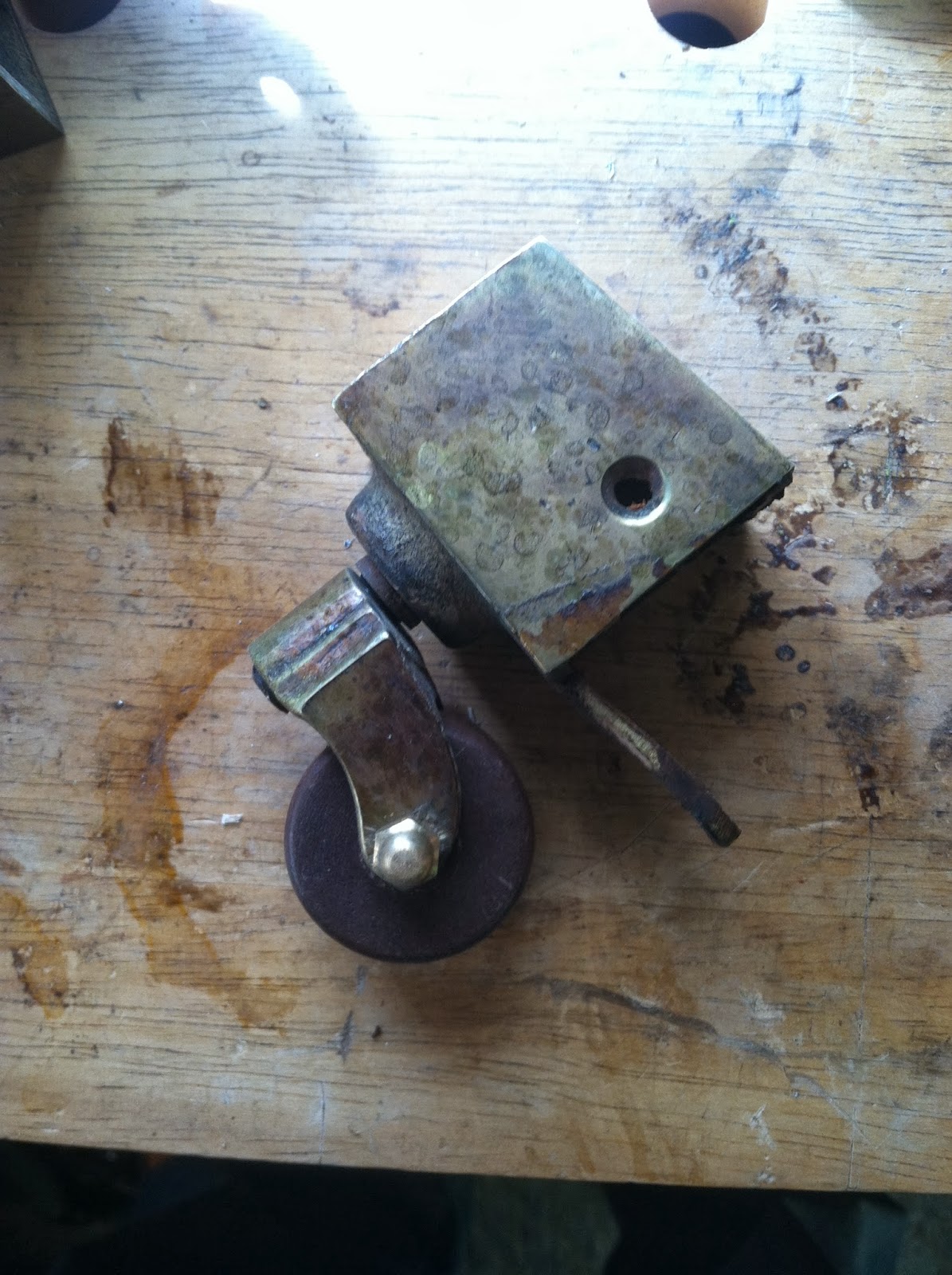
The brass casters which were causing damage to the customers floor were removed from the housing that attaches them to the table. The brass shoe that attaches to the leg and the housing were kept. In place of the brass wheels, wooden wheels of the same diameter and thickness were removed from another set of casters and modified so that they could be attached to the table's casters. Below are a few photos of this process.

This photo shows a jig created to hold the wood wheel in place while the center hole was bored out. The following photo shows a wheel in the jig. The next photo shows the bored hole in one of the wheels.


In this enlarged hole was inserted an aluminum sleeve. The sleeve helped the wood wheel from rubbing against the axle and wearing. The two photos below show the aluminum sleeve being cut to the proper length.


After they were cut, the sleeves were inserted into the wheels and set aside. The actual axle used was a brass bolt which was cut to length as seen in the photos below. The brass bolt was inserted through the housing and the wheel and then a brass acorn nut was attached on the threaded side of the bolt to keep it in place. the bolt was locked in place with locktite to prevent it from un-threading when in use. The beauty of this was that the bolt could be removed if one of the wheels were broken or worn and we provided an extra set of wheels if this happened.

This photo shows the completed caster assembly. the next photo shows all of the casters with the brass cleaned and the new wheels in place.

Back to the table, this photo shows the table with the tape removed from the satinwood border. This photo was taken during the finishing process.
The remaining photos show the table completed with and without leaves. It was a rainy day so no photos could be taken outside, but it looked really nice inside as well!