Welcome to my blog which follows my furniture restoration business. Please feel free to comment at the bottom of the post, and if you would like a response please leave your email address. you can also contact me directly at info@johnmarkpower.com. And by all means, if you like something please feel free to share it.
Showing posts with label Elm. Show all posts

Tuesday, September 8, 2015

Some Recently Completed Pieces

19th Century English Cherry Dressing Table
I have developed a bit of a backlog of photos of completed work over the past couple of months. In an effort to catch up I am showcasing some of the more interesting pieces that have come through the shop recently. Below I will describe the pieces and the work we did to them.

1. English Lath Back Windsor Chair
 This was one of my favorite chairs to ever come through the shop. It is a Lath Back Windsor made from various woods including beech and elm. It was made sometime in the middle of the 19th century. 

These chairs are great, they have great form and are very comfortable. This one had loosened up so I glued the loose joinery. The wear on the chair was wonderful, especially on the arms, so we simply cleaned and waxed the finish.

2. Four Ladderback Chairs
 
These chairs are pretty run of the mill, and were probably made around 50 years ago. I chose these to showcase the great job my caner did on the rush seats! Beyond the seats, I glued the loose joinery, and cleaned and waxed the finish.

3. Parquet Table with Draw Leaves
I have written about draw leaf table before on this blog. All of the examples that come through the shop seem to be from the early part of the 20th century. This one was made form European walnut and beech. It had a French country style, and was probably made in France or possibly another country on the European continent. This table was in pretty rough shape, so we removed the finish and refinished it with a French Polish finish.


 4. Walnut Breadboard End Table 
This table came from Switzerland and was made from old boards of European walnut. That being said, it was made fairly recently. I liked this table a lot because it reminded me of the first dining table I made, which was also of walnut. The finish was in bad shape, so we refinished this with a French Polish finish.


 5. English Cherry Dressing Table
This was a sweet little table, made from European cherry in the early part of the 19th century. Despite the cabinetmakers attempts to use good straight grained wood, the back legs had warped severely! Because it was stable and there is no real way to fix this, I left them as is. This piece was refinished with a French Polish finish.


6. Walnut Drop Leaf Table
This table had some beautiful walnut veneer, as seen in the photo below. It was made in the 1930s and I refinished it with a French Polish and found a new walnut knob for the drawer.


7. Reproduction John Shaw Four Drawer Chest
This chest was a lovely reproduction of  a chest made by John Shaw (1745- 1829), a cabinet maker from Annapolis, Maryland. The reproduction was made by Biggs Furniture of Richmond, Virginia. The chest, like the original, had beautiful crotch mahogany on the drawer fronts. Quite a lovely piece, reproduction or not!

8. Mahogany Display Stand
 
This stand had a lot of work put into it. The top was edged with inlayed banding, some of which was missing and we had to recreate. We also glued the loose joinery, replaced some of the glass, covered the bottom with felt, and refinished the entire case.


I am sure I have more photos like these so I will probably be putting together another post soon of pieces that were recently restored.

Wednesday, September 25, 2013

Lenzkirch Wall Clock (ca. 1878)

The Completed Clock

A piece I recently worked on was a German Wall Clock made by the Lenzkirch Clock Company ca. 1878. The clock had several markings on the movement which shed light on to the age of the clock. The first marking found said "D.R.P. May 21 1878". D.R.P. is short for Deutsches Reichspatent which is a German patent prior to May 1945. With this in mind the earliest possible date of manufacture of this clock would be after the patent date.

Below this marking were stamped the numbers 8160. This is a model number for the movement and not a serial number. According to a website on Lenzkirch clocks, the serial numbers were around  627,912 by this time. A little research showed that this model was a spring wound wall clock with an asymmetrical arbor. The asymmetrical arbor was probably an attempt to maintain the torque on the mainspring, allowing the clock to keep a more constant time. 

The other stamp on the clock was the name Lenzkirch and the letters A.U.G. . The initials stood for  Aktien (Stockholder), Uhrenfabrikation (Clock Factory), and Gesellschaft (Corporation). All of this show that the movement was made by the Lenzkirch factory in the late 19th century. 

The case for the clock was made of pine. The outer ring of the clock was made of Elm and had a brass bezel ring which surrounded the flat bezel. The clock face itself was painted on metal and had roman numerals indicating the hours. The hands were steel moon style hands.

After all of this information was gathered, I set about my task of restoring this clock. In addition, I was asked to replace the movement with a modern quartz movement so that the clock would keep good time and would not have to be wound. The clock hung high on the customer's kitchen wall so winding it was a chore. 

I had no problem with doing this because I was able to replace the movement without permanently altering the clock. I did this by first removing the movement and then replacing it with a wood block that the quartz movement would attach to. The face would then attach to the new movement. I was even able to find moon style replacement hands for the new movement (nice, but not as nice as the originals!). The procedure of switching the movements was relatively straightforward and allowed for the clock to be admired as well as used. I then cleaned the glass and the case of the clock and returned it and the movement to the owner. Below are some photos prior to the case being cleaned followed by some photos of the movement and the completed clock.

This photo shows the clock as it came to me.
The original movement and the chime removed from the clock.
The next two photos show the stamps on the clock movement.

This block was used to attach the new movement and position the face in the right place.
The completed clock with the new moon style hands.

Here is a link to a website on the Lenzkirch Clock Company: http://www.lenzkirchclocks.com/

The company closed its doors in 1933.

Tuesday, September 17, 2013

Biedermeier Three Drawer Chest (Ca.1830)

The Completed Chest

One of the recent pieces to come through the shop was a Beidermeier chest of drawers. The chest was made of Elm and Pine and was veneered with bookmatched Elm veneer. Judging by the style of lock used and case construction methods used, I dated this piece to around 1830, however it could be a little earlier or later. The chest has many issues when it came into the shop.The chest had loose and missing veneer across the entire case as well as many other structural repairs one would expect to see on a piece of this age. In addition, the finish was very worn and close examination revealed that there were orbital sanding marks in the wood left by a electric random orbital sander, indicating that the finish was not original. With this in mind the finish was removed and the entire case sanded after the repairs were made to remove the orbits. Below are a few photos of the chest as it came into the shop.

The photo below shows a large section of loose and missing veneer on the top. This was later lifted, cleaned, reglued, and patched where the veneer was missing.
This photo shows the top when it first came to the shop. The area photographed above can be seen on the right side of this photo.
The front skirt of the chest was a solid em board that was applied to the front of the case. The feet, which were originally supported by glue blocks, were broken off. Fortunately the customer had the feet.


This next photo shows one of the broken feet being attached to the case.

The drawers showed significant wear on the bottom edges of the sides from rubbing on the interior drawer runners. The worn wood was removed and patched with new pine. The two following photos show the new wood being glued in place.

A variety of clamping operations can be seen in this photo. On the top, patches are being glued in place. Inside the case a clamp can be seen holding several lengths of 2x4 lumber against an interior runner that was being glued in place. Also visible in this photo on the left side of the case is a long wedge driven into a gap between two boards. This wedge was glued in place and pared down flush with the side of the case once the glue had dried. The gap had occurred due to shrinkage between the two boards over time.
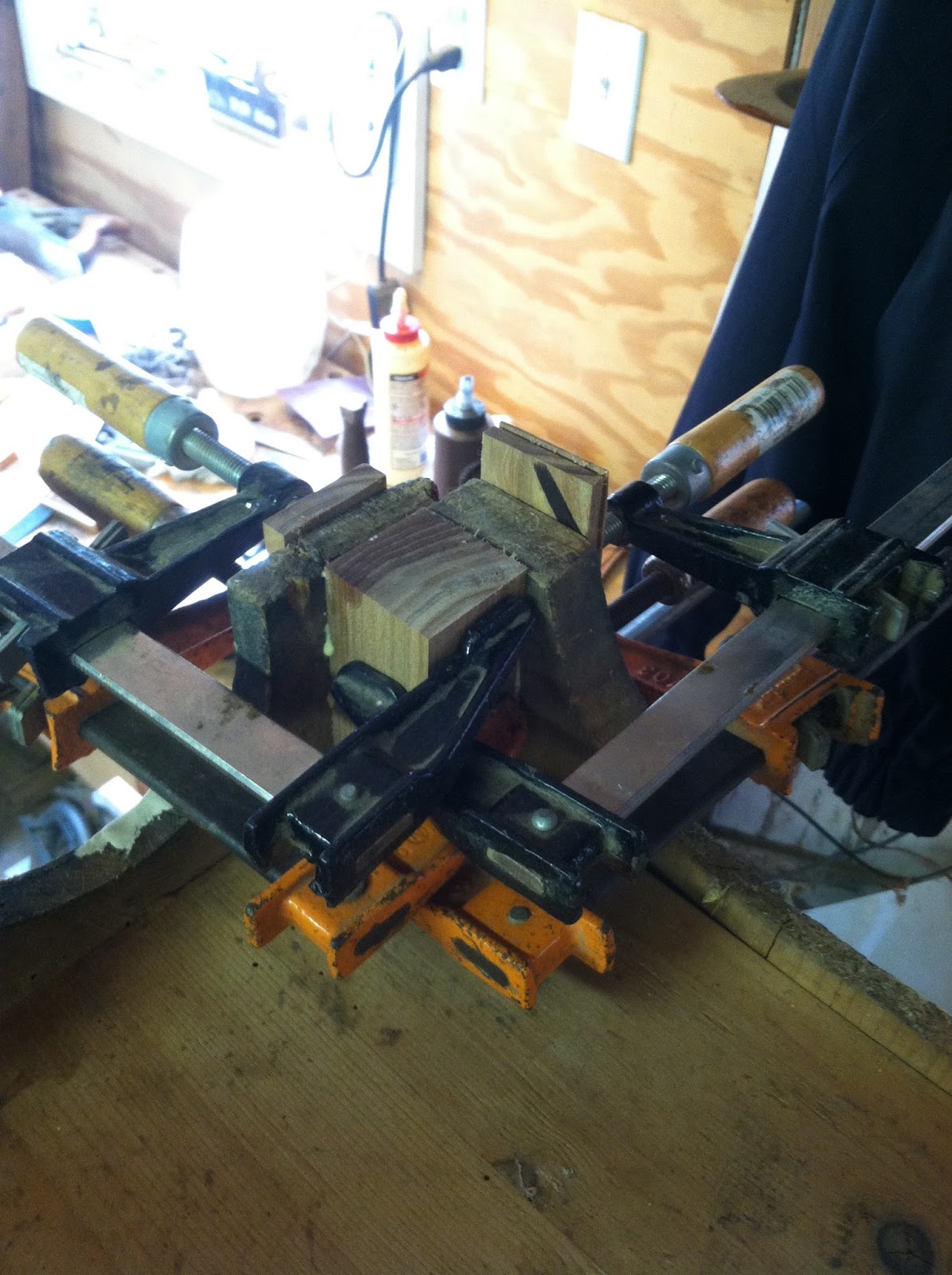
The entire bottom of the case was missing the corner blocks which act as feet. The blocks are visible in the front so Elm was used. Below is a photo of the block being glued in place. It was later carved to match the rounded profile of the case.
After the block was glued the broken section of the foot was re attached, as seen in the photo below.
Above the feet on the front of the case were two rounded elm appliques that were decorative in nature. One was missing entirely and the other disintegrated while being patched. Both were replaced with Elm as seen in the photos below.


The next three photos show the rear corner blocks being glued in place. The last photo also shows several other clamping operations.


This photo shows the case repaired and sanded.
These last photos show the chest completed with a French Polish. The replacement escutcheons were provided by Nancy Anderson at Londonderry Brasses (http://www.londonderry-brasses.com ). They really fit the style of the chest well. Thanks also to Jesse Melton, who completed most of the work on this piece. Good job Jesse!